

Let’s Talk About Writing Failures
3 Lessons I’ve learned from my mistakes, and what I’d love to learn from yours

For most of my life, I misunderstood failure. I thought it was something to avoid at all costs!
If I failed a test, received criticism, or was rejected, I saw it as proof that I wasn’t good enough.
What I’ve learned through years of writing, publishing, and marketing is that failure isn’t usually the end of the story.
More often, it’s where the story begins.
Failure only becomes permanent when we stop trying.
Failure in writing hurts because writing is personal. We don’t just submit words; we submit pieces of ourselves. That’s why rejection, criticism, and unfinished projects can feel so discouraging. Yet those experiences are often where the greatest growth can happen.
This month, I want to explore some of the most valuable lessons I’ve learned from things that didn’t go according to plan. Not because I enjoy failing, but because many of my biggest breakthroughs came from experiences I would have gladly avoided at the time.
I want to encourage writers to learn by doing. No amount of reading about writing can replace the lessons that come from sitting down, putting words on the page, sharing your work, and discovering what happens next.
The writers who grow aren’t the ones who never fail.
They’re the ones who keep writing after they fail.
This week, I’ll start with lessons I’ve learned from failures in writing itself.

1. Failing to schedule writing time and protect it
I remember staring at my list of writing ideas and wondering why I rarely seemed to make progress. I wasn't lacking ideas. I wasn't lacking desire. I was simply waiting for the perfect time to write—a time that never came.
For years, I treated writing as something I would do when I had spare time. I enjoyed writing, but I was also a people pleaser. This meant that everyone else’s projects and tasks took priority over mine. Unsurprisingly, spare time rarely appeared. I constantly pushed aside my writing to take care of more “urgent” tasks.
A combination of unfinished projects, entering my first major writing competition, and conversations with other writers forced me to confront a hard truth: if writing mattered, it deserved a place on my calendar. Writing time turned from a suggestion into an important appointment. In fact, I set my alarm clock to wake me up 30 minutes earlier, so I had uninterrupted writing time. When I began treating writing with the same respect I gave meetings and other commitments, my consistency (and progress) improved dramatically.
2. Failing to accept feedback that could strengthen my work
As a child, I also struggled with criticism. This transferred over into my writing. I viewed criticism as a threat rather than a gift. I had difficulty separating my writing from my personal character. I took criticism personally and wanted validation more than improvement. The problem was that validation made me feel good, but feedback made me better.
Over time, I learned that thoughtful feedback helps reveal blind spots I can’t see on my own. I learned to welcome beta readers into my writing process. (Substack provides a great opportunity for this.) Not every suggestion should be accepted, but resisting feedback simply because it makes me uncomfortable prevents growth. (My rule of thumb is that if I receive similar feedback from two or more people, I need to consider what they are saying and make edits.) Some of my strongest writing emerged after I listened carefully to critiques I initially wanted to dismiss.
3. Failing to view rejection as part of the journey
Rejection letters used to feel deeply personal. Each one seemed like confirmation that my writing wasn’t good enough.
Now I see rejection differently.
The only writers who never receive rejection are the ones who never submit their work.
If someone takes the time to answer a query, I take it as a win. Sometimes it means the work needs improvement. Sometimes it means the piece wasn’t the right fit for that publication or audience. Either way, rejection provides information. Every rejection is an opportunity to learn, revise, and continue searching for the readers who will best connect with my work.
Looking back, these weren’t really failures at all. They were lessons disguised as failures.
The lesson behind all three experiences is the same: growth comes from engagement, not avoidance. We improve by writing, sharing, receiving feedback, facing rejection, and writing again.
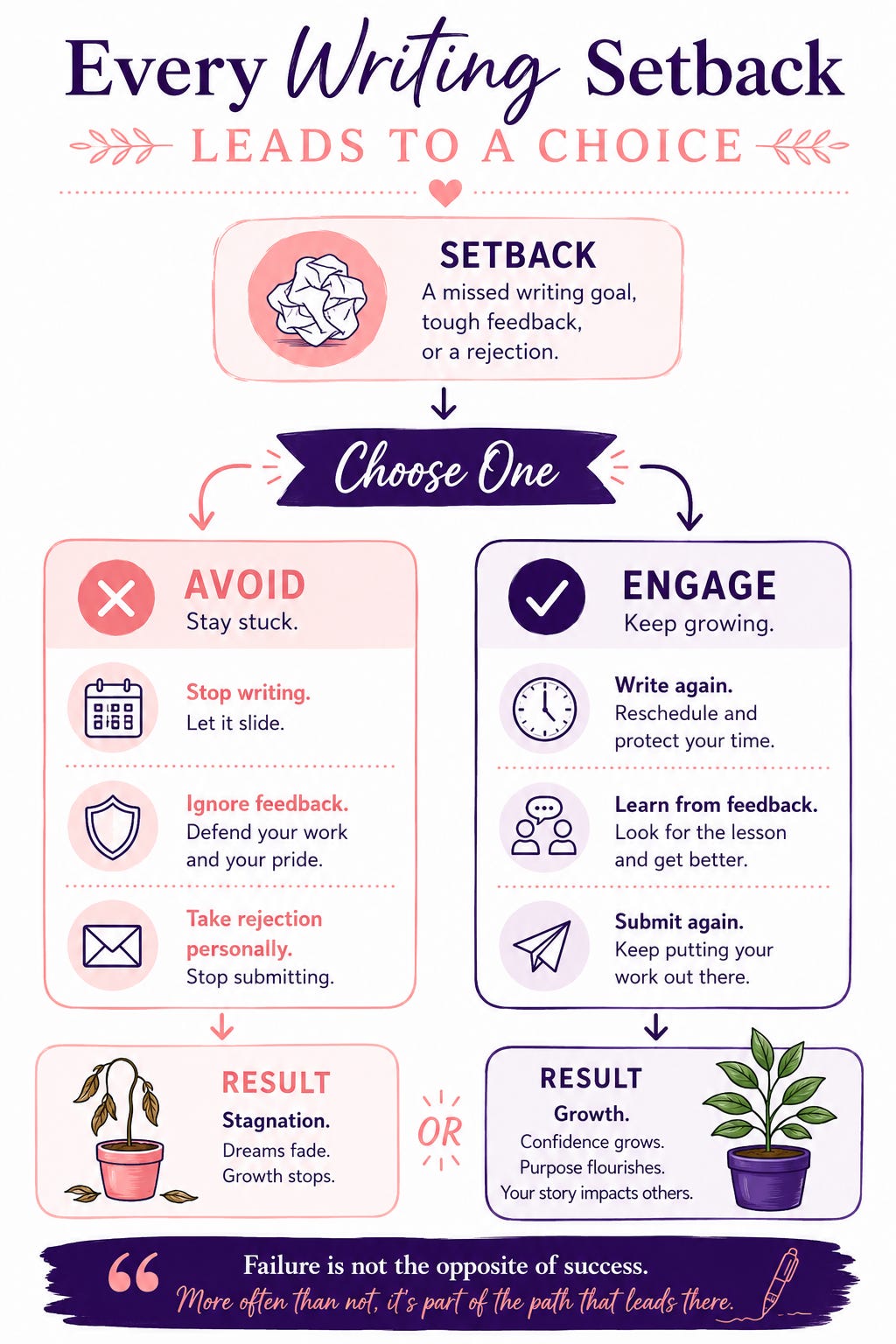
Failure is not the opposite of success.
More often than not, it’s part of the path that leads there.
What’s one writing “failure” that taught you something valuable?
Share your story in the comments. One of the gifts of writing communities is discovering that the struggles we thought were unique to us are often experiences many of us share.
And if you’re looking for support in developing a sustainable writing practice or navigating the challenges of publishing, feel free to reach out.
Blessings,
Ruth
Nicely said Ruth, yes true failure is actually never trying again and again while it helps you see your blind spot and in the process speak to more of those who appreciate the connection.
Let’s talk about writing failures…you still print? ;D